A Granada Spain hidden gems tour is the perfect way for the sophisticated traveler to go beyond the iconic sights and truly understand the artistic and spiritual depth of this city. While most visitors spend their time at the Alhambra, those who seek a deeper connection with history know that Granada hides some of the most spectacular Renaissance and Baroque monuments in Europe. A professional Granada Spain hidden gems tour reveals a side of the city that is quiet, majestic, and deeply moving.
As a local guide, I often notice that travelers from the U.S. and Canada are overwhelmed by the beauty of the Nasrid art, but they are equally fascinated by the grandeur of the Christian monuments that followed. Projects like the Monastery of San Jerónimo or the Cartuja Monastery represent a Golden Age of Spanish architecture. Choosing a Granada Spain hidden gems tour allows you to experience these sites without the crowds, giving you the space to appreciate the intricate details that make Granada a unique cultural crossroads.
The Monastery of San Jerónimo: A Renaissance Masterpiece
The first stop on many a Granada Spain hidden gems tour is the Monastery of San Jerónimo. This was the first monastery to be built in Granada after the Christian conquest, and it is a masterpiece of the Spanish Renaissance. The architectural harmony of its double-cloisters and the orange trees in the central courtyard offer a sense of peace that is hard to find in more touristy areas.
The heart of San Jerónimo is its Main Chapel. When you enter this space during your Granada Spain hidden gems tour, the sight of the massive, gilded altarpiece (retablo) is truly breathtaking. It is one of the most significant works of art in Andalusia, filled with sculptures and paintings that tell the story of the life of Christ and the saints. This monastery is also the final resting place of the “Great Captain” (El Gran Capitán), Gonzalo Fernández de Córdoba, the legendary military leader who served the Catholic Monarchs. Understanding his legacy is key to understanding the rise of the Spanish Empire.
The Cartuja Monastery: The Jewel of Spanish Baroque
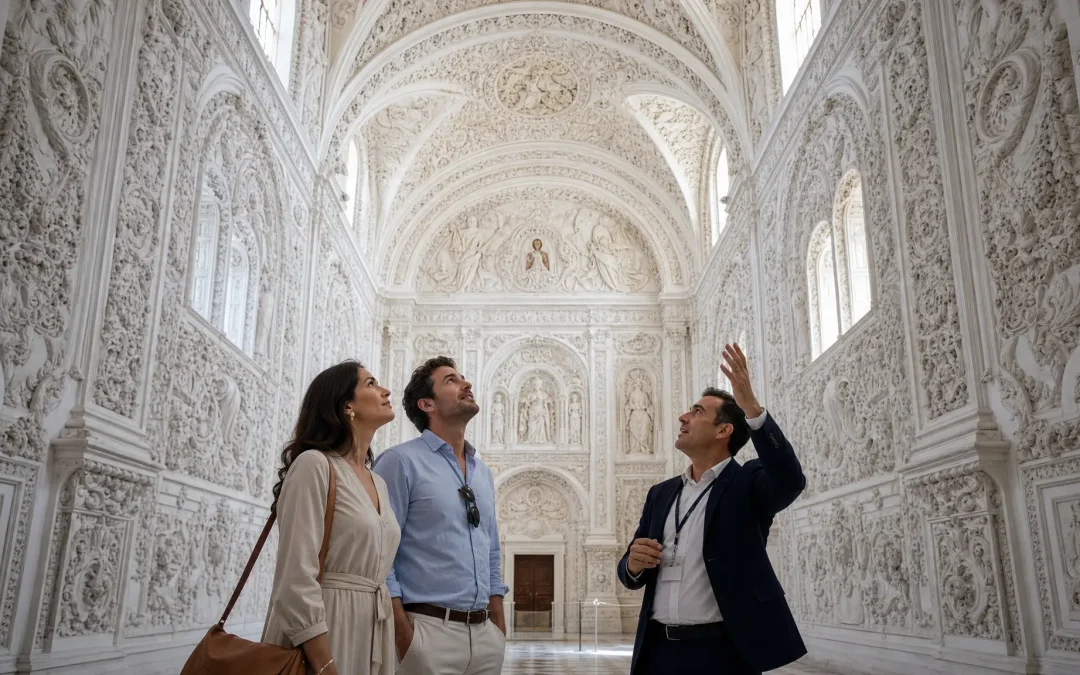
No Granada Spain hidden gems tour would be complete without visiting the Monastery of La Cartuja (The Charterhouse). Located slightly outside the city center, this hidden jewel houses what is arguably the most spectacular Baroque interior in Spain. While the exterior of the building is sober and austere—reflecting the silent life of the Carthusian monks—the interior is an explosion of light, gold, and white stucco.
The Sacristy of the Cartuja Monastery is often called the “Christian Alhambra” because of the incredible complexity of its white stucco work. The way the light interacts with the geometric and organic forms creates a celestial atmosphere. On a Granada Spain hidden gems tour, we spend time here just absorbing the detail; the contrast between the monks’ simple life and the divine luxury of the chapel is one of the most fascinating themes in Spanish art history.
The Basilica of San Juan de Dios: Gold and Devotion
Another essential part of a Granada Spain hidden gems tour for lovers of art and history is the Basilica of San Juan de Dios. This church is the ultimate expression of the Late Baroque style in Granada. Every inch of the interior is covered in gold leaf, paintings, and intricate carvings. It is a space designed to inspire awe and devotion.
Beyond the gold, the Basilica holds the tomb of Saint John of God, the patron saint of hospitals and the sick. The silver work and the craftsmanship in the camarín (the small chamber behind the altar) are of a quality rarely seen outside the Vatican. Including this site in your Granada Spain hidden gems tour provides a look into the religious fervor and the artistic wealth that defined Granada in the 18th century.
Why These Sites Benefit from a Private Guide
The challenge with these “hidden gems” is that their beauty is often hidden behind layers of complex history and theology. A Granada Spain hidden gems tour is not just about looking at beautiful buildings; it is about decoding them. Why is there a circular courtyard in one palace and a double-cloister in another? What do the different saints on the altarpiece represent? How did the transition from Islamic to Christian rule change the way architects used light and space?
With a private guide, your Granada Spain hidden gems tour is adapted to your pace. We avoid the bus schedules and the large groups, allowing you to stay as long as you want in front of a painting or a particular piece of architecture. It is a more intimate and intellectual way to see Granada, focusing on quality and depth rather than just surface-level sightseeing.
Discovering the Palaces and Courtyards of the Realejo
A Granada Spain hidden gems tour can also take you into the Realejo, the old Jewish quarter. Here, hidden behind high walls, are some of the city’s most beautiful private courtyards and small palaces. Sites like the Cuarto Real de Santo Domingo (a 13th-century Almohad palace) or the Casa de los Tiros offer a glimpse into the domestic luxury of different centuries.
These spots are often ignored by the guidebooks, which only makes visiting them as part of a Granada Spain hidden gems tour more special. You get to see the “real” Granada—the one where history is a living part of the neighborhood. It is the perfect complement to the grand scale of the monasteries, showing the human and domestic side of the city’s heritage.
Common Questions About Granada’s Hidden Gems
How long does a Granada Spain hidden gems tour take?
Usually, a tour focusing on the main monasteries and a few central hidden spots takes about 3 to 4 hours. Because these sites are spread out, we often use a private car to move efficiently between them.
Do I need to book tickets in advance for these monasteries?
Unlike the Alhambra, these sites rarely sell out. However, on a professional Granada Spain hidden gems tour, your guide handles all the logistics so you can simply walk in and start exploring.
Is there a lot of walking involved?
The monasteries themselves are quite compact, but there is some walking within the cloisters and chapels. We can adapt the route of your Granada Spain hidden gems tour if you have limited mobility, ensuring you see the most important areas comfortably.
What is the best time of day to visit?
Mornings are usually best for the monasteries, as the light in the chapels is natural and soft. Some of these sites also close for a few hours in the middle of the day, so a Granada Spain hidden gems tour is carefully timed to ensure we see everything on your list.
Are these sites open all year round?
Yes, the major monasteries and the Basilica of San Juan de Dios are open throughout the year, though they may have restricted hours during certain religious holidays. A professional Granada Spain hidden gems tour always takes these factors into account during the planning phase.