The Palace of Charles V in the Alhambra is one of the most unexpected and fascinating buildings you will encounter when visiting Granada. Standing in sharp contrast to the delicate stucco work of the Nasrid Palaces, this massive square building holds a secret architectural heart: a perfectly circular courtyard. Understanding the Palace of Charles V in the Alhambra is key to grasping the complex history of Spain, as it represents the meeting point between the medieval Moorish past and the imperial Renaissance future.
As a local guide, I often see the surprise on my guests’ faces when they see the imposing stone facade of the Palace of Charles V in the Alhambra. While some early travelers thought it felt out of place, today we recognize it for what it is: a brilliant masterpiece of Italian-style architecture in the heart of Spain. Exploring the Palace of Charles V in the Alhambra allows you to see how the Holy Roman Emperor, Charles V, wanted to establish his legacy within the most beautiful fortress in the world.
A Circular Courtyard in a Square World
The most striking feature of the Palace of Charles V in the Alhambra is undoubtedly its central courtyard. It is the only one of its kind in the world. When you step inside, you are surrounded by two levels of elegant columns—Doric on the bottom and Ionic on the top—forming a perfect circle within a square exterior. This design was incredibly advanced for its time and remains a highlight of every visit to the Palace of Charles V in the Alhambra.
The symmetry and the acoustics of this space are legendary. Today, the courtyard of the Palace of Charles V in the Alhambra is used as a prestigious venue for classical music concerts. Standing in the center of this circle, looking up at the blue Granada sky, gives you a sense of balance and grandeur that is completely different from the intimate, narrow corridors of the nearby Moorish palaces.
The Exterior: Imperial Strength and Symbolism
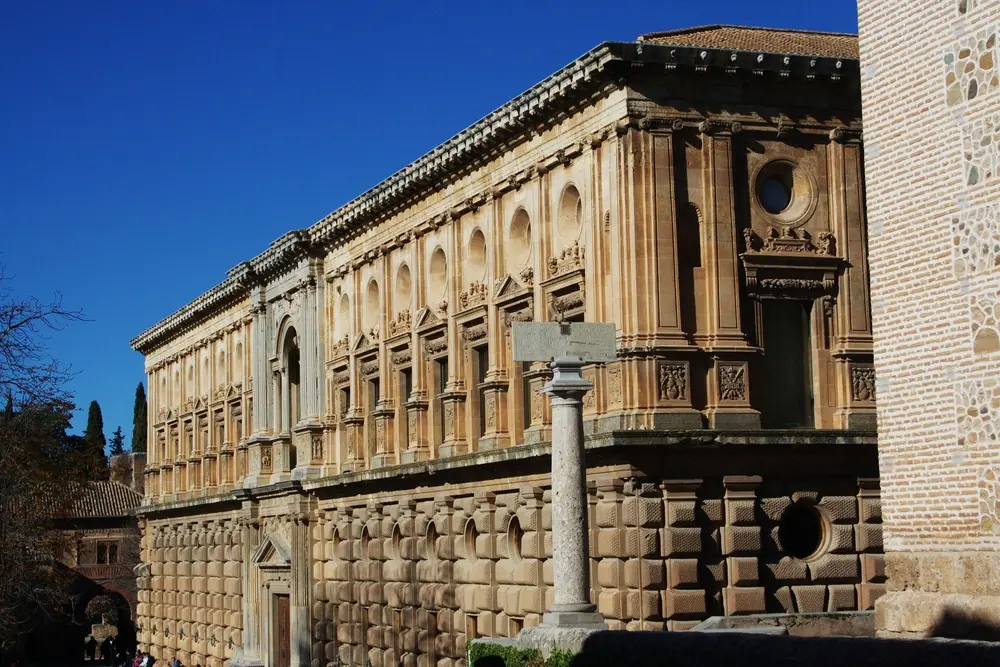
The exterior walls of the Palace of Charles V in the Alhambra are just as impressive as the interior. The building uses a technique called “rustication,” where the stones are carved to look heavy and powerful. If you look closely at the facades, you will see intricate bronze rings shaped like lion heads and eagles. These details on the Palace of Charles V in the Alhambra were meant to symbolize the power and reach of the Spanish Empire during its Golden Age.
Walking around the perimeter of the Palace of Charles V in the Alhambra, you can see how the Christian architecture was built to dialogue with the existing Islamic structures. Instead of destroying the Alhambra, the Emperor chose to build his palace within it, creating a unique layers-of-history experience.
Museums Inside the Palace of Charles V in the Alhambra
Many visitors do not realize that the Palace of Charles V in the Alhambra now houses two of the city’s most important museums. On the lower floor, you will find the Museum of the Alhambra, which contains the best collection of Nasrid art and artifacts in existence. On the upper floor, there is the Museum of Fine Arts of Granada. Visiting these museums inside the Palace of Charles V in the Alhambra gives you a deep, intellectual understanding of the cultural evolution of Andalusia.
Common Questions About the Palace
Is there an extra ticket to see the Palace of Charles V in the Alhambra?
The Palace of Charles V in the Alhambra is located in one of the free-access areas of the Alhambra complex. However, to visit the museums inside or to combine it with a larger guided tour, having a professional by your side is much better.
Why does the Palace of Charles V in the Alhambra look so different?
It represents the “High Renaissance” style that was popular in Italy at the time. The contrast between the Palace of Charles V in the Alhambra and the stucco and tiles of the Islamic architecture is intentional.
How much time should I spend at the Palace of Charles V in the Alhambra?
A good visit to the Palace of Charles V in the Alhambra, including its facade and a walk through the circular courtyard, takes about 15 minutes. It is a perfect, quick stop to admire the Renaissance architecture before moving on. However, if you decide to explore the museums inside, you should add another hour to your schedule.